The declaration came about nine months after the JSW Group had entered the automobile business after forming a joint venture with China-based SAIC Motor, which now owns the British-origin MG brand of vehicles.
Jindal’s intention of doubling down on the automobile business will culminate in India getting its first new homegrown carmaker this millennium. But why does a legacy group, whose cash cow is the steel business, want to get into the intensely competitive automobile sector given the risks?
India’s car market is one of the most consolidated in the world. According to data from government portal Vahan, the top four carmakers—Maruti Suzuki, Mahindra, Tata Motors and Hyundai—controlled about 80% retail market share of the 4.5 million passenger vehicle market at the end of 2025. Much of that share comes from internal combustion engine (ICE) vehicles, which make up 70% of the market.
Brands such as Ford Motor, General Motors have fallen by the wayside in the ICE rink over the years, while other foreign giants, including Volkswagen Group, Nissan and Renault, continue to struggle.
JSW, however, has no plans to skate on ICE, and will instead focus on new age vehicles, hybrids and EVs, which made up just 7% of the country’s total passenger vehicle market at the end of 2025 (CNG vehicles account for the remaining 23%). Industry estimates, including from Hyundai Motor India and JSW MG Motor, suggest that EVs and hybrid vehicles will constitute about 30% of the overall market, which is expected to hit the 5.6-6 million mark by 2030.
A hybrid and EV-focused product push, collaborating with foreign players on various vehicle and plant technologies, building large product capacity and tapping its JV with MG Motor for help appear to be the broader contours of the conglomerate’s plan.
The new opportunity
While JSW has not made its plans clear, there is a glimmer of clarity on some fronts. The group’s automobile ambitions are being spearheaded by a company called JSW Green Mobility. The name underlines that the company’s focus will be on hybrids and electric vehicles, both commercial and the passenger kind.
JSW Green Mobility has two subsidiaries—JSW GreenTech Ltd, which will make commercial vehicles, and JSW Motors, which will focus on passenger vehicles.
The partnership with China’s SAIC for JSW MG Motor India is unrelated to the above companies and was made by JSW Ventures, a separate group company.
While the group is yet to roll out a vehicle, JSW Motors is expected to launch its first vehicle in the October to December quarter.
Outlining JSW’s approach in an emailed response to Mint, Ranjan Nayak, the man chosen to drive JSW’s car ambitions, said the opportunity for a fresh automobile brand lies in the new energy vehicle space. “Consumer mindsets are shifting, technology transitions are reshaping cost structures and product architectures, and the traditional advantages of legacy players are being redefined,” Nayak wrote. “This is an opportune time for new home-grown players with in-depth manufacturing expertise in capex-intensive industries,” he added.
While hybrid technology is currently offered only by Maruti Suzuki, Honda Cars and Toyota Kirlosokar, the EV leaderboard has been volatile. As of January, brands in the EV space included Tata Motors, JSW MG Motor, Mahindra, Vietnam’s Vinfast and Chinese giant BYD. Maruti Suzuki has just started selling its EVs in India while Hyundai’s Creta electric has seen little traction.
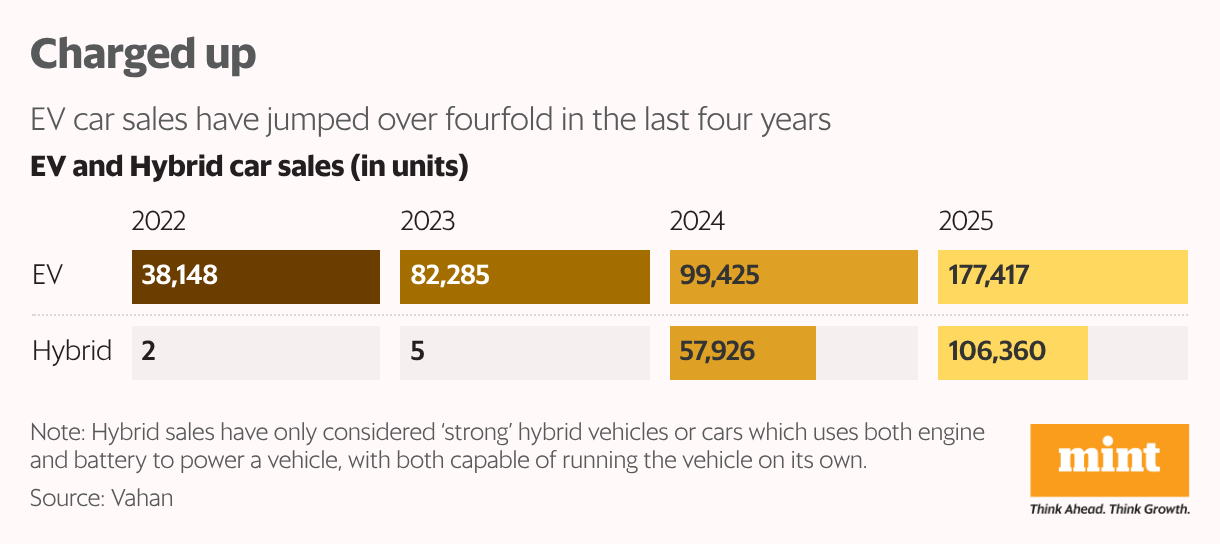
In 2025, both strong hybrid vehicles and electric vehicles saw a strong surge in growth. While strong hybrid vehicles grew 83% to close at 106,000 units, EV sales grew 77% to 177,000 units.
Input advantage
The JSW Group, which was founded by Sajjan Jindal in 1982, has mainly been in the steel, infrastructure and energy businesses but has diversified to an extent in recent years. One edge the automobile subsidiary will enjoy thanks to the group’s varied interests lies in access to raw materials and power, which will help it manage costs better.
For any vehicle, steel is among the most basic requirements. On average, according to JSW, 60-65% of a vehicle’s weight would come from steel. “It makes sense for the country’s largest steel producer to own a car company; automotives being the largest consumer of steel. This strategic integration is how the Japanese keiretsu and South Korean chaebols have historically thrived in adjacent industries,” Rajendra Srivastava, Novartis professor of marketing strategy & innovation at the Indian School of Business, said.

View Full Image
Paints are another key input that the company will be able to source internally, from group company JSW Paints, which has more than 400,000 kilolitres of capacity. Industry estimates suggest a small car could require 2-4 litres of paint while a bigger car could require around 6 litres.
Plant operations also need huge amounts of power, both thermal and renewable, which JSW Energy produces. Another pillar of the vertical integration strategy will be the company’s latest auto component venture, JSW AutoComp, which was established last June.
Most of all, both hybrids and EVs will need batteries, and on that front, a total 50GWh of EV battery capacity is expected to be completed in three phases by 2032, according to a presentation made by the company to a Japanese delegation in July, a copy of which Mint has seen. Jindal confirmed in December that the company’s lithium-ion battery giga factory will come up in Nagpur to aid in localisation.
“JSW will build a battery cell manufacturing facility in Maharashtra, while JSW Motors is actively exploring partnerships with global players, including companies from China, Korea, and other markets, to access advanced and scalable technologies,” Nayak added.
Technology partnerships
While borrowing from the playbook of the Indian companies such as Tata Motors and Mahindra as it looks for access to technology outside, JSW has much more direct and aggressive plans in place with an eye on China unlike its rivals, who looked West.
Speaking on the sidelines of the World Hindu Economic Forum in December, Jindal said the group is lining up technology partnerships in various countries, including China, Germany and the UK.
Nayak told Mint that the company has to acknowledge the global reality that Chinese automakers have taken a lead in electric and hybrid technology. “Our approach is aligned with this global reality. We are evaluating partnerships with globally relevant players that serve diverse overseas markets at scale, ensuring that any collaboration is benchmarked against international standards and future-ready platforms,” Nayak said, without revealing any details.

View Full Image
Puneet Gupta, director at S&P Global Mobility, stated that JSW can have a proven and strong product lineup if it gets access to technology from Chinese carmaker Chery Automobile, which it is in talks with. “Being able to offer products of the highest quality, which is possible by collaborating with China, can help the brand gain quick traction in the Indian market,” Gupta added.
While the core vehicle technology is expected to be Chinese, to be gradually localised in India, the company is simultaneously working with Indian companies such as Jio, Tata Elxsi, and KPIT to develop software and other technological capabilities for its vehicles, said Nayak.
“On manufacturing and operations, our focus is on learning partnerships with German and Korean players, who bring deep strengths in precision engineering, automation, quality systems, and process excellence,” said Nayak.
But for all the talk, the status of the company’s technological partnerships is still not clear. Aside from Chery Automobile, JSW has held parleys with at least four Chinese companies—Gotion, Cospowers, Svolt and Soundon—for battery technology and Geely for vehicle platforms, Mint reported on 2 September. But the path forward is unclear for now.
The MG overhang
While the company’s commentary has pointed towards hybrid technology, it still has not indicated which type of hybrid it will be. Executives in the know suggest that it will be a plug-in hybrid with a range extended electric vehicle (REEV) potentially coming later.
The bet on hybrid vehicles is supposed to act as a hedge against being conflated with the company’s other automobile brand, JSW MG Motor India. Currently, more than three fourths of JSW MG Motor’s sales come from electric vehicles.
“From a technology standpoint, while JSW MG has a strong focus on EVs, JSW Motors is evaluating a broader technology mix, including hybrids and other alternative powertrains,” Nayak said.
But MG Motors is also not shying away from the hybrid space. In an interview with Mint, the company’s managing director, Anurag Mehrotra, said that the carmaker will bring plug-in hybrids into the country starting this year as there are still apprehensions about EVs in consumer minds.
But will this put it in direct competition with its sister JSW Motors and lead to overlaps? “The question is more suitable for JSW Motors to answer,” said Mehrotra, dodging the query.

View Full Image
Nayak is confident that two brands within the same group will not be a problem as both will have distinct products, technology and an identity. JSW Motors will also look to tap MG Motor for synergies in areas such as distribution network to build its business in the Indian car market.
Massive capacity
Regardless, the result of the partnerships being inked will come together at a mega 500,000-unit facility being built in Chattrapati Sambhaji Nagar in Maharashtra. Nayak confirmed that the plant will be scalable to 1 million units per annum depending on the needs of the company.
The initial installed capacity will be among the largest in the Indian market after the top four carmakers. “At a future stage, we remain open to exploring export opportunities, particularly in the context of evolving global trade and emerging market dynamics. Recent foreign trade agreements and developments in European markets also present potential avenues that we will continue to evaluate as part of our long-term growth strategy,” Nayak added.
The company is also believed to be planning experience centres across 10 to 12 cities.
The retail expansion plan includes turning to MG Motor India, which has been selling in the Indian market since 2019. “We will evaluate synergies within the broader group ecosystem, including with JSW MG Motor India, wherever such collaboration enhances operational efficiency, speed to market, or customer experience,” Nayak added.
Interestingly, Nayak doesn’t have an automobile background. He has come into the role after a decade in JSW Group’s steel business. His leadership team comprises two distinct pools of talent, one from the conglomerate’s own businesses and the other from across the automobile sector.
Vice president and chief marketing officer Ravinder Jain joined from Tata Motors, where he spent more than a decade as head of brand marketing.
Chief financial officer Balajirao Pothana, who has also been inducted into the board, joined from renewable energy company AM Green Group. A.S. Dahiya, who was associate vice president at JSW Steel, was inducted into the company’s board as additional director in October. Chief commercial officer Amit Jain joined in January after a seven-year stint at auto retail company Jubilant MotorWorks Pvt Ltd. Raskhit Bisaria, former general manager and domain head at Hyundai Motor India, joined in December as head of product planning and strategy department.
While the company has been able to put its plan together in a relatively short period of time, it is anybody’s guess whether Sajjan Jindal’s dream will lead to a Maruti moment. The JSW Group founder is not one to shy away from risk, especially in the steel business, as he has proved in the past. But unlike steel, a business he has been in for decades, the automobile landscape is relatively uncharted territory. Will the risk-taker be able to script a success here as well? Or will he meet the fate of the many carmakers who crashed and burned by the wayside? India’s roads will reveal the answer in time.
Key Takeaways
- Sajjan Jindal is doubling down on the automobile business.
- It may culminate in India getting its first new homegrown carmaker this millennium.
- JSW has no plans to skate on ICE, and will instead focus on new age vehicles, hybrids and EVs.
- The new carmaker can leverage the group’s access to raw materials and power.
- This strategic integration is how the Japanese keiretsu and South Korean chaebols have historically thrived.
- In addition, the group is lining up technology partnerships in various countries, including China, Germany and the UK.
- The bet on hybrid vehicles is supposed to act as a hedge against being conflated with the company’s other automobile brand, JSW MG Motor India.