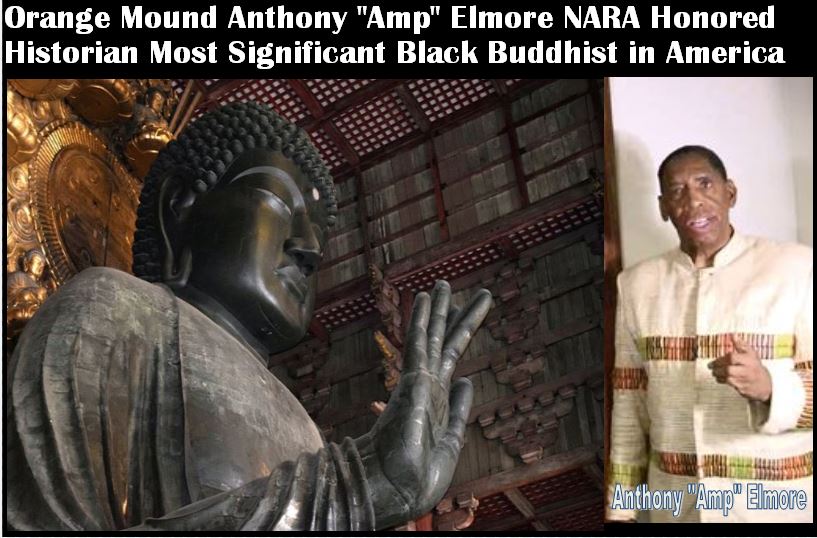
NARA Honored Historian Anthony “Amp” Elmore The Most Significant Black Buddhist in America
Anthony “Amp” Elmore Memphis 1st Independent 35mm theatrical Filmmaker, African Cultural Diplomat, 5-Time World Kickboxing Champion, Creator 1st biopic Film of Buddhist, Father of Black Memphis History, Founder Proud Black Buddhist World Association
MEMPHIS, TN, January 29, 2026 /24-7PressRelease/ — Click here to see a May 29, 1982 image of Anthony “Amp” Elmore in the Memphis Commercial Appeal Newspaper getting ready for his World Title bout that was aired on E.S.P.N.
The 1982 *Memphis Commercial Appeal* photograph of **Anthony “Amp” Elmore** training with World Champion **Bill “Superfoot” Wallace** is more than a sports clipping; it is a primary source document that anchors the “Father of Black Buddhist History” in a legacy of world-class excellence.
While the article captures Elmore preparing for a PKA World Heavyweight Title bout on E.S.P.N., it reveals a deeper spiritual truth: by 1982, Elmore had already practiced the “religion” of “Zen Buddhism” whereas he became a Nichiren Buddhist in 1974. Elmore started his training in 1970 in Old Japanese Shotokan Karate a form of Zen Buddhism as a student at Memphis’ **Hamilton High School**.
The Memphis newspaper image is culturally significant because it physically connects the historic Black community of Orange Mound to the inner circle of Elvis Presley. Bill Wallace, the epitome of American Karate, was personally hired by Elvis Presley to lead the Tennessee Karate Institute (TKI)**. Via Bill “Superfoot” Wallace being featured at the Elmore home at 1035 Semmes Street, Elmore demonstrated that Orange Mound was not just a residential neighborhood, but a global center of intellectual and martial arts sovereignty.
The late Karate-ka Joe Lewis was considered the most significant Karate-ka in America history spent a week at Elmore’s home training and working out with Elmore.
As a “NARA-honored contributor Anthony ‘Amp’ Elmore, whose historical work is documented in the National Archives and recognized in the Congressional Record (E1233) Anthony “Amp” Elmore utilizes this documented history to challenge the digital erasure of Black agency. The 1988 film The Contemporary Gladiator—the world’s first Buddhist biopic—was born from this same Orange Mound soil and this same rigorous “Old Japanese Shotokan” discipline.
The photograph of Anthony “Amp” Elmore and Bill “Superfoot” Wallace proves that before the world knew Anthony “Amp” Elmore as a filmmaker or a historian, Elmore was already a “Contemporary Gladiator” who integrated Eastern philosophy into the heart of the American South, forever cementing his status as the Most Significant Black Buddhist in America.
The 1988 Anthony “Amp” Elmore Film Release “The Contemporary Gladiator” is the 1st biopic film of an American Buddhist in World Film history. In the world of the Buddhist religion in America it is ground-breaking, culturally significant and historic that the 1st biopic movie of a Buddhist in America is Memphis 1st Independent 35mm theatrical film “The Contemporary Gladiator,” the story of a “Black Buddhist:” Anthony “Amp” Elmore who lives in the Memphis, Tennessee historic African American Memphis Community of Orange Mound.
Click here to see condensed synopsis of the Buddhist scenes in the 1988 film “The Contemporary Gladiator.” The video is titled: Anthony Amp Elmore Black Movie Contemporary Gladiator 1st Biopic of a Buddhist in World Film History.
The 1988 release of The Contemporary Gladiator stands as a monumental landmark in American history because it represents the first time a Buddhist biopic was created and released by a Buddhist practitioner in world film history. While Buddhism has been practiced in the United States for over a century, the narratives had not included Black history, culture and language.
Anthony “Amp” Elmore broke this mold by writing, producing, directing, and starring in a 35mm theatrical feature that chronicled his own Buddhist journey, effectively making a Black man from Memphis the pioneer of the 1st Buddhist biopic in American film history.
The film’s inclusion touches upon the then phenomenal growth of Buddhism in America. Many soldiers who were stationed in Japan and Okinawa married Japanese women who were introduced to an organization that started in America in 1960 called NSA or Nichiren Shoshu of America, a lay Buddhist organization based in Japan.
NSA attracted many who were outside of main stream America. Many were hippies and Black Revolutionaries and those who challenged injustices in America. In the case of Anthony “Amp” Elmore he remembers going to his 1st NSA Buddhist meeting after a morning of Karate training in the woods with karate sensei (teacher) Julius L. Dorsey.
Elmore recalls we were punching trees with our bare hands whereas we knocked the skin off our hands that were bleeding. The object was to build callous hands and feet whereas you could walk around barefoot. This was part of the “Zen Buddhist Training.” The meetings were held in the homes of White people in the rigid segregated parts of Memphis. This group had mantra “World Peace via Individual happiness.”
Those who joined the Buddhist sect were issued an object of worship called a “Gohonzon” a scroll with Japanese writings. Those who accepted faith were visited by the group to enshrine the Gohonzon in a 1st temporary Buddhist altar made of card board.
The White leaders did not hesitate to come into the Black Community. Nichiren Buddhism was the opposite of Zen Buddhism whereas there no strict practices, quiet meditation of Buddhist disciplines. It was just chanting and reciting the lotus Sutra in Shindoku a form of Japanese phonetics.
Anthony “Amp” Elmore notes when I joined the Buddhist sect I loved the beautiful Japanese altar whereas Elmore took out a loan and purchased a large Black Japanese alter and would later decorate his living room via oriental furnishings.
When the Gohonzon was enshrined both Blacks and Whites came to Elmore’s Orange Mound home for the enshrinement ceremony. Anthony Elmore would boast that he was a Japanese in his past life because of is deep connection to Japanese culture and history.
Fast forward to 1987 when Anthony “Amp” Elmore shot the Buddhist scenes in his movie “The Contemporary Gladiator” he filmed the scene in his Orange Mound home in Memphis and used his Buddhist Altar.
Elmore asked his Black Buddhist teacher “The late Joseph Thomas” to play himself in the movie. There is a Scene selling carpet and the NSA scene Mr. Thomas played himself. Joseph Thomas was a 20 year retired army soldier who was introduced to Buddhism in Okinawa.
In regards to NSA Buddhism Anthony “Amp” Elmore held meetings at his Orange Mound home. In 1958 there was a “Soul Singer” by the name of “Jerry Butler” who records a Soul Classic Song in 1958 titled “Four You Precious Love.” We assume privately Jerry Butler a NSA or Nichiren Shoshu Buddhist.
Jerry Butler had a concert in Memphis and Anthony “Amp” Elmore asked him to attend a Buddhist meeting at his Orange Mound Home. Jerry Butler led the prayers and conducted the Buddhist meeting. Jerry Butler was known as “The Ice Man” who was induced into the Rock and Roll Hall of fame. Anthony “Amp” Elmore is honored that “The Iceman” Jerry Butler came to Orange Mound to lead a Buddhist discussion meeting.
In the context of Orange Mound, “The Contemporary Gladiator” film is a critical piece of the “Black Buddhist Category” of history that challenges the erasure of African American agency. By transforming his Orange Mound home at 1035 Semmes Street into a Hollywood movie set in 1987, Anthony “Amp” Elmore demonstrated that the Orange Mound community was not just a residential enclave, but a center of global cultural production and intellectual sovereignty.
The movie connects Anthony “Amp” Elmore a local resident of Orange Mound—a community Elmore has documented as beginning in 1879—to a global spiritual philosophy and the international stage when the movie premiered Nairobi, Kenya in 1990.
Click here to see a December 28, 2025 You Tube Video titled: NARA Historian Anthony Amp Elmore Honored on Floor of Congress Corrects Orange Mound Birthdate 1879
This achievement recognized December 18, 2025 via Memphis Congressman Steve Cohen who entered the name Anthony “Amp” Elmore and the community of Orange Mound in the Congressional Record (E1233), elevates Orange Mound’s status from a local neighborhood to a site of global history, ensuring that the legacy of Anthony “Amp” Elmore creating a African Mud Cloth Tuxedo for President Obama and the mention of the movie ” The Contemporary Gladiator” is preserved as an essential chapter of the American story.
Anthony “Amp” Elmore the writer, producer, director and star of the film who started his Buddhist practice in 1970 via “Old Japanese Shotokan Karate” while a student at Hamilton High School in Memphis at 17 years old. Anthony “Amp” Elmore an Old Japanese Shotokan Karate-ka studied a culture of Karate that integrated “The Japanese Bushido Code” into his Karate practice as well as “Zen Buddhism.”
In 1986 African/American filmmaker Spike Lee made a Black and White film titled; “She’s Got Have it.” Inspired by Spike Lee Anthony “Amp” Elmore made the decision to make a movie and tell his story. Elmore’s logic was Sylvester Stallone made Rocky whereas he was not a real champion, whereas Elmore’s goal was an avocation of equality in America.
In regards to Black America “Hollywood left Black movies out.” The story was told via a February 1987 release by Black Filmmaker Robert Townsend who used his credit cards to produce a spoof about the injustices of Hollywood in the film “Hollywood Shuffle.”
Click here to view a November 22, 1987 story in the L.A. Times titled; Films going into production: THE CONTEMPORARY GLADIATOR
Linn Sitler the Memphis Shelby County Film Commissioner along with the Shelby County Historical Commission and the silence of Black Memphis leaders Linn Sitler used her function and authority to erase Anthony “Amp” Elmore’s Film history in Memphis. The Contemporary Gladiator is not only Memphis 1st Independent 35mm Theatrical Film, “The Contemporary Gladiator” is the 1st Kickboxing film in World Film history.
The above image of Anthony “Amp” Elmore and Bill Wallace connects Anthony “Amp” Elmore and the Elvis Presley and the Orange Mound connection. Elvis Presley loved Karate more than he loved life. In 1974 Elvis Presley opened the TKI or the “Tennessee Karate Institute.” Elvis Presley hired his long time body Guard Red West and Bill Wallace to operate the Karate school.
Unknown and untold to many, Elvis Presley shot scenes for in documentary movie titled “The New Gladiators” at his TKI Karate School in Memphis. In 1974 Anthony “Amp” Elmore a hot shot Karate fighter went to the TKI Karate School and sparred with Bill “Superfoot” Wallace in a Karate match.
Anthony Elmore explains that the match was one of the “Highlights of his life.” People travel worldwide to touch upon the life of Elvis Presley whereas Anthony “Amp” Elmore has published many Black stories relating to Elvis Presley. The image of Bill Wallace and Anthony “Amp” Elmore is historic. Anthony “Amp” Elmore had no idea the image existed until he did a search of stories written about him in the Commercial Appeal newspaper.
Anthony “Amp” Elmore notes had Elvis Presley lived to May 29, 1982 it might have been Elvis Presley in the photo with Elmore. Elmore accomplished what Elvis Presley did not. Elvis opened a Karate school and in 1974 he started production of his film “The New Gladiators.”
On May 29, 1982 Anthony “Amp” Elmore was fighting Demetrious “Oak Tree” Edwards for the PKA Heavyweight title. Elmore traveled to Atlanta, Georgia whereas Issac Hayes had moved to Atlanta Elmore went to Atlanta to ask Grammy and Oscar winner Issac Hayes to sing the National Anthem at the fight. Elmore had earlier introduced PKA Karate to Memphis whereas in October of 1981 he was the 1st to bring E.S.P.N. to Memphis.
Click here to see a video of Anthony “Amp” Elmore on Memphis television in 1980 Titled: Anthony Amp Elmore from Kickboxer to Film Director/ Producer
Anthony “Amp” Elmore created a “Kick Boxing Culture” in Memphis that lead to the Mid-south becoming a hub for Karate and Kickboxing Champions. Elvis Presley a Karate fan would have been thrilled that Memphis had become focal point for Karate/Kickboxing in Memphis a dream that Elvis Presley looked to attain via in movie he started called “The New Gladiators.”
The Anthony “Amp” Elmore never set out to make a Buddhist movie, or the 1st Kickboxing movie in world film history or to make Memphis 1st Independent 35mm Theatrical film. The most important goal for Anthony “Amp” Elmore was “inclusion” whereas African/Americans had a story tell and be part of America’s story.
Most important the film presents the unknown and untold Black prospectives of both early Buddhism in America and early Karate and African/American cultural practices. We see the movie “Karate-Kid” that came out in 1984 and in 2010 actor Will Smith son Jaden Smith played the re-make of “Karate Kid” with Jackie Chan. We see stories of both a Black and White youth being introduced to martial Arts via an oriental Karate master.
In America we see stories of skinny little White kids who study Karate to become strong. There are no stories of Black kids who study Karate or stories of their Black Karate teachers. Most African/Americans are known for traditional sports, football, basketball, baseball, track and Boxing, but not Karate an eastern philosophy and sport not see in the Black community.
Click here to view national news story titled : Uniting America Through Elvis A Black Man’s Story of Heritage, Orange Mound, Black History, Diversity, Equity and Inclusion a New Legacy for Elvis Fans
In creating the film “The Contemporary Gladiator” Anthony “Amp” Elmore asked his real Karate master the late Julius L. Dorsey to play himself in the movie. The Elmore story is a semi-autobiography film whereas we see the unknown and untold actual Black “Old Japanese Shotokan Karate” master who plays himself in the movie and not some actor.
In Nichiren Buddhist Buddhism Anthony “Amp” Elmore notes the name of a Nichiren Buddhist writing titled “HO’ on-Sho” or Repaying Four Debts of Gratitude. The concept notes four Debts of gratitude. I. Debts we owe to our parents or those who took care of us. II. Debts to our teachers who guided us. III. Debts of our sovereign or our Community IV debts to our Gods.
Anthony “Amp” Elmore explains in regards to the film “The Contemporary Gladiator” is a way of paying a debts of gratitude. The late Julius L. Dorsey was his Karate master who never charged him a cent whereas he was a tough and strict teacher whereas it was more easier being a world champion than going through the Julius L. Dorey Karate Class. Elmore notes we had to break our knuckles on a concrete wall, meditate in Icey waters, and take cold showers and learn to “bear the pain.”
Anthony “Amp” Elmore explains “The Contemporary Gladiator” is not only the “1st Kickboxing movie in World Film history” it is the most Nichiren Buddhist movie in American film history. The film shows the unknown story of an actual “Black Karate Master” in a true life story whereas most of the characters actually played themselves. Elmore ask the Memphis Buddhist community to play themselves. The late Tommie Lee Ray a Nichiren Buddhist and Memphis actor played the role of Elmore’s father in the movie.
In the movie “The Contemporary Gladiator” there could never be the movie without “The Kingfish” payed by George Marshall Young. From 1951 to 1953 Black actors starred in the Black Sitcom “Amos ‘N” Andy” one of worst Black racial stereo characters in American history.
Not everyone saw Amos ‘N’ Andy as bad. George M. Young called himself “The Kingfish.” George M. Young took it as a badge of honor running schemes and shams. In the 1991 movie “The Five Heartbeats” J.T. says he would do anything to trick a woman into sex. This is the story of the Kingfish.
The Kingfish was no good while at the same time he was beloved like the character of “Fred G. Sanford” of the sitcom “Sandford and Son.” Fred G. Sanford was no good while at the same time loved. This is who the Kingfish was in the movie “The Contemporary Gladiator.”
Anthony “Amp” Elmore sent his movie script to Black film producer Bill Wallace who asked was this character “Kingfish Real” and who were we casting to play the “Kingfish.” George M. Young played himself and spontaneously created his own unique words that was hilarious. While some may not understand there are characters in the Black Community that are simply funny. The “King Fish” in Amos and Andy the 1951-1953 sitcom that was later syndicated was not all bad. The characters were immaculately dressed and show much historical relevance in American in early 1950.
While a student activist at Hamilton High School in Memphis in 1970 Anthony “Amp” Elmore was the 1st in Tennessee to lead 18 year of voter registration via an organization called “The Inner-City Voter Education Committee” in 1971.
The Japanese Bushido code known as “The way of the warrior” is the ethical and philosophical framework of the samurai, Japan’s warrior class, emphasizing virtues like loyalty, honor, courage, respect, honesty, righteousness (justice), and benevolence, guiding their lives, conduct, a martial arts and Zen Buddhist practice.
The significance of The Contemporary Gladiator becomes unmistakable when you place it in its proper historical, cultural, and religious context. The Professional Karate Association (PKA) first appeared on ABC’s Wide World of Entertainment on September 14, 1974, showcasing the first World Professional Karate Championships where Joe Lewis, Bill Wallace, Jeff Smith and others became the PKA first full-contact champions or what we know today as world Kickboxing champions.
In regards to this story let’s move back to 1974 whereas there was a “Karate craze in America” whereas Kickboxing was a brutal sport known as Thailand Kickboxing. In order to sell this new sport in America was to associate the name to Karate whereas we had the birth of “Full Contact Karate” accepted and known today as Kickboxing.
In 1988—long before Hollywood embraced Buddhist narratives, long before Tina Turner’s story reached the screen, and long before digital platforms democratized storytelling—Anthony “Amp” Elmore created the first biographical film in world cinema centered on an American Buddhist, and that Buddhist was Anthony “Amp” Elmore a Black man from Orange Mound.
This wasn’t an institutional production, not the work of a Buddhist sect, and not a priest‑driven narrative. It was the lived, organic, self‑authored journey of an African American who embraced Buddhism on his own terms and documented it through unheard of power of Black independent filmmaking in Memphis.
As Memphis’ first 35mm theatrical film, it also placed a historically Black neighborhood at the center of a global religious milestone. That combination—Black agency, Buddhist identity, independent cinema, and cultural diplomacy—makes The Contemporary Gladiator not just a film but a groundbreaking moment in American Buddhist history and Black world history, whereas Anthony “Amp” Elmore declares via our Black Buddhist history Anthony “Amp” Elmore is “The most significant Black Buddhist in America in regards to “Black Buddhist History.”
The two pivotal figures who helped establish independent Black churches in America were Richard Allen and Absalom Jones, who, after experiencing racism at St. George’s Methodist Church, co-founded the Free African Society and later led separate paths, with Allen founding the African Methodist Episcopal (AME) Church and Jones the African Episcopal Church of St. Thomas.
The absolute undeniable documented fact is that in 1998 Anthony “Amp” Elmore created the 1st “Black Buddhist website in world history titled “Proud Black Buddhist. Org.”
Click here to view the “Proud Black Buddhist” Website as it was capture by the “WayBack” the Internet Archive Machine dated October 3, 1999. There is no individual Black or White Buddhist in America or the world that had a Buddhist Website in 1998
This 1999 technological marvel of a machine called “WayBack” explains or notes why Anthony “Amp” Elmore is the most significant Black Buddhist in America. In 1998 Anthony “Amp” Elmore created a website called “Proud Black Buddhist.Org.” The 1999 capture of the website says: “The Web Page Where Africans & African/Americans tell their Stories Black Style & Proud of our Faith in Nichiren Shoshu Buddhism.”
This website is a captured time capsule and a documented history of the cause and effect breakup of the lay SGI Buddhist sect and the Nichiren Shoshu Temple and the story of how it affected Blacks in Buddhism. Most important this Anthony “Amp” Elmore website is a “declaration of independence.”
A paragraph of the welcome page of the website reads: “This Web Site is an ethnic Web Site” and we make no apology for being Buddhist, Black and proud. Some Africans and African/Americans are embarrassed about this site and they are quick to tell white people and Japanese that they do not agree with this site. If this site cause any discomfort just simply go to a site that is more pleasing.
Most of us Africans and African/Americans were once a part of the SGI Soka Gakkai and the SGI Elmore noted and found disgusting that the Japanese leader George Kusaba had brothers and sisters speaking with Japanese accents and acting Japanese. One of the greatest benefits that many Africans and African/Americans have leaving the SGI Buddhism is that we can be Black and proud again.”
In the website Anthony “Amp” Elmore created a space for Black for Black history and culture. One such story and we find on the website was written by John Ellis a sax player who play with everyone like James Brown, Chaka Kalm, The O’Jays, Lou Rawls, Ray Parker, Doc Serverinsen and the list goes on. When John Ellis decided to join Nichiren Shoshu and not SGI he mentions that both of Tina Turner’s Son joined him. There is a picture on the website of John Ellis with Tina’s late son Ron Turner on bass guitar, whereas the site is historic. Black Buddhist scholars like Alan Billups contributed to the website where one can reach his teachings and Buddhist explanations.
The archived 1999 Proud Black Buddhist website represents one of the earliest, clearest, and most irrefutable pieces of evidence that Anthony “Amp” Elmore is the most significant Black Buddhist in America. At a time when the internet was still young, when most Buddhist organizations had no digital presence, and when Black voices in American Buddhism were nearly invisible, Elmore created a fully developed, culturally grounded, unapologetically Black Buddhist digital platform and website called “Proud Black Buddhist.org.”
Click here to visit the proudblackbuddhist.org website that has been around at the time of this publishing 2026 for 28 years.
This was not a simple personal page or a hobbyist experiment. It was a structured, multi‑page educational site with photographs, commentary, cultural framing, and a mission: to give Africans and African Americans a space to tell their Buddhist stories in their own voice. In 1999, this was revolutionary. It positioned Elmore not as a follower of Buddhist institutions, but as a **creator of a new cultural lane** within American Buddhism.
The significance of the site becomes even clearer when placed in historical context. In the late 1990s, the dominant narratives about Buddhism in America were shaped almost entirely by white convert Buddhists and Asian‑led institutions. Black practitioners were rarely acknowledged, and there was no public platform where Black Buddhists could articulate their own identity, history, or cultural interpretation of the teachings.
Elmore’s website broke that silence. It asserted that Black people had a rightful place in the Buddhist world and that their experiences deserved documentation. This act alone — the creation of the first Black Buddhist website — makes Elmore a foundational figure. But the site also reveals something deeper: he was not simply practicing Buddhism; he was **documenting, interpreting, and shaping Black Buddhist history decades before academia, media, or mainstream Buddhist institutions recognized the need for such work.
The website also demonstrates Elmore’s long‑standing commitment to cultural diplomacy and historical preservation. The language, imagery, and structure show a deliberate effort to connect African identity, African American identity, and Nichiren Shoshu Buddhism into a unified narrative.
This was not accidental. It was part of a larger vision that Elmore had already been building through film, martial arts, international cultural exchange, and community education. The site is an early digital expression of a lifelong mission: to create a Black Buddhist space that is culturally authentic, historically grounded, and globally connected. No other Black Buddhist figure in America was doing this work at that time — not in film, not in digital media, not in historical documentation, and not in cultural diplomacy.
Furthermore, the 1999 archive provides timestamped, third‑party verification of Elmore’s pioneering role. Anyone can claim to be a leader. Anyone can claim to be first. But the WayBack Machine provides **independent, federally recognized digital evidence**. It shows that Elmore was shaping Black Buddhist identity online before YouTube existed, before Facebook existed, before Wikipedia existed, and before the modern “People of Color Buddhist” movement emerged.
This is not opinion — it is documented fact. When combined with Elmore’s 35mm Buddhist film (the first in world history), his NARA‑recognized historical archive, his thousands of lectures, his creation of the Proud Black Buddhist World Association, and his decades of cultural and diplomatic work, the website becomes part of a larger mosaic that no other Black Buddhist in America can match.
In short, the 1999 Proud Black Buddhist website is historically significant because it captures the moment when Anthony “Amp” Elmore publicly established the first independent Black Buddhist digital institution in American history. It proves that he was not simply a practitioner, but a **pioneer, archivist, filmmaker, philosopher, cultural diplomat, and movement builder**.
It shows that he was shaping Black Buddhist identity long before the rest of the world recognized its importance. And it confirms, through verifiable digital evidence, that Anthony “Amp” Elmore is — by documentation, by cultural impact, by historical firsts, and by federal archival recognition — **the most significant Black Buddhist in America**.
The Anthony “Amp” Elmore “Proud Black Buddhist” website is revolutionary because the website gives a space for Afro-Centric views. In the movie the Contemporary Gladiator there is a scene with the late Joseph Thomas who Elmore calls his Buddhist Father. In 1998 when Anthony “Amp” Elmore went to opening of the 1st Nichiren Shoshu Temple in Africa in Accra, Ghana Anthony “Amp” Elmore changed where he saw Blacks practicing Buddhism inclusive of African life and culture.
Anthony “Amp” Elmore was the official videographer for the opening of the 1st Nichiren Shoshu Buddhist Temple in Accra, Ghana in1998. In 1998 when Anthony Launching the website: Proud Black Buddhist. org.
Click here visit the website ProudBlackBuddhist.org as it was captured in 1999 via the WayBack Machine that captured the website as it was on October 3, 1999 and other dates.
In 1998 this website positioned Anthony “Amp” Elmore as a groundbreaking figure whose influence reached far beyond traditional Buddhist structures. At a time when even major temples and institutions had not yet embraced the internet, Anthony “Amp” Elmore created one of the earliest Buddhist websites in the world—and the very first dedicated to Black Buddhist history and culture.
This act alone marked Anthony “Amp” Elmore as a digital pioneer, but the deeper significance lies in how he used the platform. Rather than limiting the site to sectarian doctrine, he built an accessible, secular “Black Space” that centered on not only the cultural, historical, and spiritual experiences of the African diaspora. In doing so, Anthony “Amp” Elmore introduced a new model of Buddhist propagation—one rooted in the inclusion of Black Buddhist History.
The Proud Black Buddhist website became a global tool for Black Buddhist History education and empowerment long before Buddhist organizations understood the power of digital outreach. Through the proud Black Buddhist. Org website Anthony “Amp” Elmore challenged the long‑standing Asian cultural dominance whereas Anthony “Amp” Elmore is the 1st Buddhist to the Buddhist practice the inclusion of “Black Buddhist History.”
Anthony “Amp” Elmore shaped the 1st Black Buddhist identity in America. Anthony “Amp” Elmore articulated a “Black Language” of the Lotus Sutra that spoke directly to African American experiences. This combination of digital innovation, cultural leadership, and narrative reclamation is a major reason Anthony “Amp” Elmore stands as the most significant Black Buddhist in America.
Fast forward to 2026 and ask the question what is the line of demarcation between Anthony “Amp” Elmore and almost every Black Buddhist in America. The line that separates Anthony “Amp” Elmore is “Black Buddhist History” Anthony “Amp” Elmore has written, lectured and document more about Black Buddhist history than anyone in World history.
Click here to view the educational Black Buddhist video title: NARA Honored Historian Anthony “Amp” Elmore Black Buddhist Challenge Nation of Islam Black Muslims
Anthony “Amp” Elmore Proud Black Buddhist challenges the Black Muslims “Nation of Islam.” The video lecture by NARA Honored Historian Anthony “Amp” Elmore represents a unique intellectual challenge to the Nation of Islam (NOI), moving the discourse of Black liberation from a traditional theological platform to one of rigorous historical and scientific scrutiny. In this dynamic presentation, Elmore asserts that the foundational concepts of the “Black God” taught by the NOI find their true articulation in ancient Black Buddhist traditions.
By referencing the 1836 work The Anacalypsis by Godfrey Higgins, Elmore argues that the seat of global civilization began with Buddhism in the Indus Valley—a culture that predates Saudi Arabia and the rise of Islam by thousands of years. He challenges NOI scholars, like Dr. Wesley Muhammad, to present evidence from archaeology, anthropology, and linguistic science that could counter the claim that Black Buddhism is the primary source of the “sacred science of the Black God”.
This historical confrontation is rare in American discourse because it pits a practitioner of a global spiritual philosophy against a major Black separatist organization using the “facts of history” as the primary weapon. Elmore positions Black Buddhism as a “Warrior-Scholar” tradition, rooted in his own 1970s karate training and his world championship kickboxing legacy, which he argues has the intellectual depth to stand “toe-to-toe” with any revolutionary organization.
By reclaiming the “Black Buddha” as an African and Kushite figure, Elmore seeks to establish a new paradigm for Black History Month that centers on intellectual sovereignty and the scientific verification of ancient Black achievement. This challenge serves as a call for a modern re-classification of Black agency, urging a move away from “Roman teachings” and towards a dharma-based understanding of the African past.
Click here the view the Anthony “Amp” Elmore video posted on You Tube January 26, 2026 titled: NARA Honored Historian Anthony “Amp” Elmore: “Buddhism for Black Americans”
Anthony “Amp” Elmore notes that Black Buddhist history has been extricated from Buddhist teachings whereas Buddhist History is Black History is not told to Black America. Anthony “Amp” Elmore who is “The Father of Black Buddhist History release a 1:20 minute education dissertation on Black Buddhist History.
Orange Mound’s Anthony “Amp” Elmore stands as the most significant Black Buddhist in America because his life’s work forms the only fully documented, federally archived, and culturally grounded record of Black Buddhist history in the United States. As a NARA Honored Historian, his legacy is not based on claims or titles but on verifiable primary sources—films, photographs, writings, international cultural diplomacy, and a groundbreaking digital archive that predates every modern platform.
Long before social media, before YouTube, and before any Black Buddhist had written a book, Elmore created the Proud Black Buddhist website in the late 1990s, giving Black practitioners a voice, a platform, and a historical footprint at a time when none existed. His work preserved the lived experiences of Black Buddhists, documented the SGI–Nichiren Shoshu era from a Black perspective, and connected African and African American identity through Buddhist philosophy in ways no institution had ever attempted.
Combined with his pioneering 35mm Buddhist film, his global cultural outreach, and his decades of teaching and documentation, Elmore’s contributions form the most extensive and influential body of Black Buddhist work in American history. His recognition by the National Archives cements this legacy, ensuring that his story—and the story of Black Buddhism through his eyes—will remain part of the permanent historical record.
The October 3, 1999 WayBack Machine archive of ProudBlackBuddhist.org represents a monumental achievement in the preservation of African American spiritual history. This digital fortress is far more than a collection of pages; it is a primary source dissertation that documents the intellectual, cultural, and spiritual independence of Anthony “Amp” Elmore” and the Black Buddhist community during the most volatile era of American Buddhism. At a time when the Black community lacked digital knowledge and major institutions were offline, Elmore established a self-authored platform that remains the most documented record of Black Buddhism in America.
One of the most profound historical pillars of the 1999 archive is the documentation of Anthony “Amp” Elmore’s unique role as a Documentary Filmmaker on the global stage. While other members were embroiled in sectarian disputes, Elmore was utilizing professional video equipment—a rarity at the time—to capture the reality of the faith across the globe. Unlike those who are writers Anthony “Amp” Elmore brought to the Buddhist faith “Documentary Filmmaking.” There are those who wrote books on Buddhism however Anthony “Amp” Elmore is the 1st writer, producer, director and start of the 1st Buddhist Biopic titled “The Contemporary Gladiator” that was released in August of 1988.
Anthony “Amp” Elmore who via film documented his 1st Trip to the Nichiren Shoshu Buddhist in Japan in 1996 in addition Elmore served as the official videographer for the opening of the First Nichiren Shoshu Buddhist Temple in West Africa in the African country of Ghana.
In 1990 the 1988 Anthony “Amp” Elmore film “The Contemporary Gladiator” premiered in Nairobi, Kenya whereas in 1992 Kenya President Daniel Arap Moi name Elmore an African Cultural Ambassador. The archive documents of Anthony “Amp” Elmore’s African Cultural Diplomacy, connects Anthony “Amp” Elmore a back to his Buddhist practice of honoring the Lotus Sutra.
Prior to travel to Ghana, Elmore took his camera directly to Japan capturing footage at the Nichiren Shoshu Temple in Taisekiji Japan at a time when Black SGI Americans were being pressured to break away from Nichiren Shoshu and become a sole member of the SGI.
Elmore return from Japan in 1996 provided a direct look at the priesthood. The archive records the internal friction this caused, including the refusal of his “Buddhist Father,” the late **Joseph Thomas**, to even view the footage—a testament to the “blind obedience” Elmore fought to break.
Anthony “Amp” Elmore as the only Buddhist practitioner Black or Whiter filming in Japan and Africa during this era, Elmore’s “Contemporary Gladiator” gave him a background to preserve Buddhist history in America.
The WayBack Machine website serves as a forensic ledger for the “trying times” following the 1991 excommunication and the fracture between the Soka Gakkai (SGI) and the Nichiren Shoshu Priesthood.
The WayBack Machine archive documents the raw, unedited dialogue of local members who visited Elmore’s home and office
The WayBack Machine Website preserves specific debates regarding splinter groups showcase works of Nichiren Shoshu Buddhist like Alan Billups who wrote articles and that of musician John Ellis who played for not only greats like James Brown, John Ellis shows the late son of Tina Turner Ronnie Turner and his band and a part of his Nichiren Shoshu group. Elmore’s unique position as an intellectual arbiter provided a stable platform for members during the organizational chaos.
Through timestamped letters—such as the March 18, 1991, letter to the NSA members the website documents Elmore’s direct challenges to Japanese-led hierarchies that systematically ignored Black leadership and cultural contributions.
Pedagogical Innovation: Black History Lectures and the “Sacred Science was a part of the Proud Black Buddhist Website. In 1999, Elmore was already utilizing the internet to host sophisticated Black History Lectures that redefined the origins of the Dharma.
Via the website Anthony “Amp” Elmore lectured on the Black Kushite and Indus Valley History. The archive presents a scientific and historical defense of the “Black Buddha,” citing 19th-century scholarship like Godfrey Higgins‘ The Anacalypsis and the to link to Black Buddhist origins to ancient African civilizations.
The Anthony “Amp” Elmore Proud Black Buddhist website documented the creation of a “Black Language” for the Lotus Sutra, where practitioners were encouraged to reject Japanese-centric postures in favor of an unapologetic **Afro-centric ethos**.
As stated earlier the unique the unique proud Black Buddhist site featured figures like saxophonist John Ellis and his connection to **Tina Turner’s family**, proving that the movement was deeply integrated into Black American cultural royalty.
The Forensic Digital Evidence pf The WayBack Machine as a Witness. The historical significance of the 1999 archive is cemented by the WayBack Machine, which provides third-party, timestamped verification of Elmore’s seniority. Elmore’s Buddhist history started in 1970 via his Zen Buddhism and Old Japanese Shotokan Karate.
Proud Black Buddhist Pre-Social Media Reach Capturing nearly 70,000 views. The website proves that Elmore’s platform was the global hub for Black Buddhist discourse years before the launch of modern digital giants like YouTube or Facebook.
The “Digital Receipt” of a NARA Historian: As a **NARA Honored Historian**, Elmore utilizes this archive to anchor his legacy in **scientific fact**. This record proves that while institutional gatekeepers tried to erase his contributions, the “Digital Time Capsule” has preserved every word, argument, and image for over a quarter-century.
In short, the 1999 **Proud Black Buddhist** website is a living dissertation of independence. It documents a 50-year “Warrior-Scholar” journey from a student at **Hamilton High** to a **5-time World Champion** and a nationally recognized historian, ensuring that the story of **Orange Mound** and **Black Buddhism** remains an irrefutable part of the permanent historical record.
Our Journey and Mission
Orange Mound, established as the first community in America built for Blacks by Blacks, has a rich history often overshadowed by negative stereotypes. Mainstream media and societal biases have painted Orange Mound as a “ghetto,” contributing to a 30% decline in property values while surrounding communities have prospered. The Orange Mound News Network was created to counter this narrative and highlight the true spirit and resilience of our community.
Anthony Amp Elmore, a five-time world karate kickboxing champion, filmmaker, and community activist, has been a beacon of change in Orange Mound. With over five decades of community service, Elmore has dedicated his life to uplifting Orange Mound. From becoming a homeowner at 19, establishing businesses, to founding the Proud Black Buddhist World Association, Elmore’s contributions have been immense.
# # #