This post may contain affiliate links. We may receive a small commission, at no cost to you, if you make a purchase. Read Disclosure.
We’ve all heard of London and its many iconic sights – The London Eye, Buckingham Palace, and the giant Blue Whale skeleton in the Natural History Museum. Even far remote tribes in the Amazon rainforest would have heard of Big Ben and Prince William.
But even though London is one of the world’s biggest tourist destinations and welcomes around 22 million people a year, it still has some hidden secrets that most tourists, and even locals, haven’t heard of. Discovering hidden gems and unique places that other travelers have missed is one of our greatest pleasures about travel.
We’ve visited London several times, and even lived there briefly, so we’re bored with the typical tourist attractions and love to get under the surface of the city. So it gives us great pleasure to share with you some of our most unique finds wandering behind the scenes in London.
In this digital age, where every square inch of the world has been photographed and placed on Google Street View, being able to discover something no one else has discovered is impossible, but we can guarantee that you’ve probably never heard of at least one of the following hidden secrets in London…
The Fireplace on Vincent Street

During the Second World War in 1946, London was heavily bombed throughout an eight-month period, famously known as The Blitz. It lasted over 8 months, and in that time, Nazi Germany led 57 consecutive nights of attacks, causing catastrophic destruction across the city, and killing approximately 43,000 people.
It goes down in the history books as one of the UK’s greatest tragedies, and even though London has been rebuilt since then, there are several places in London where remnants of this fateful time are still remembered. Famous places include the Imperial War Museum and the older London Underground Stations such as Aldwych, Bounds Green, and Trafalgar Square, but there are some lesser-known remains of this time still standing today.
One of those is the fireplace left on Vincent Street. The East End of London, where Vincent Street is located, was the worst affected by the Blitz. It’s estimated that 1 million homes were destroyed during this time, and Vincent Street used to be a row of houses. Many of those houses were beyond repair, and all that remains of the original street is this fireplace, left as a haunting reminder of all that was lost.
Cratered Wall at the Victoria & Albert Museum

On the subject of the Blitz. You may have heard of the V&A Museum, famous for its extensive historic art collection, but what most people walk past when visiting this world-class museum is the cratered wall on the outside.
On the wall facing Cromwell Road, and around the entrance on Exhibition Road, you can see shrapnel damage sustained to the museum during the Blitz. When the building underwent refurbishment, this side of the building was left unchanged as a memory for those enduring times.
In 2017, the museum removed parts of the wall to fit new gates, but the new gates were put in to reflect the war damage and include the imprints of the shrapnel damage on the stonework. So next time you visit the V&A, don’t be in such a rush to go inside.
Hannah Courtoy’s Time Machine Mouselium in Brompton Cemetery

Hannah Courtoy wasn’t anyone special in life; very little is known about her apart from the fact that she had three daughters with a much older man, who wasn’t married to her, and controversially inherited his fortune after he died.
Living in High Victorian society, she was fascinated by the Ancient Egyptians and their life and death rituals, and had this lavish tomb with Egyptian characteristics built for her to rest in after her death.
Hannah was also friends with a man called Samuel Alfred Warner, who was an inventor. It was rumoured that he tried to convince the British army to finance the development of some of the ideas, which were said to be too advanced to actually exist. She was also friends with Egyptologist Joseph Bonomi, who deciphered some of the hieroglyphics found in the Valley of the Kings, which were rumoured to be the secret of time travel.

Hannah introduced the two men and used her inheritance to finance their secret project – a time machine – which is rumoured to be buried with her.
Much of the story is speculation, but the mausoleum is beautiful. If you visit and hear some tapping, be sure to ask whether Busted’s song Year 3000 went multiplatinum, and let us know in the comments!
Eel Pie Island
Hidden between the manicured gardens of Ham House and the banks of Twickenham, is an 8.9-acre island in the River Thames that is the hippy, bohemian hub of dreams. It was named after the eel pies that were baked by locals and sold to river traders, which was an industry that didn’t last long… but long enough for the name to stick.
Today, it’s more well-known for being home to artists and creatives and was famously lived in by The Rolling Stones for five months. Each year, the residents allow visitors to their private island on only two weekends a year (usually in July and December). The doors are open so that guests can visit some of their 26 studios and experience the creative vibe. You can find out more about the opening weekends via their website.
It’s accessible by a footbridge on the left bank, and if you are lucky enough to be able to visit this exclusive island, remember that although the homes are quirky and full of artistic expression, they are still homes, and people live there. Be respectful when taking pictures.
The Crossness Pumping Station

Only in London could a sewage pumping station be beautiful. Built in 1865, the Crossness Pumping Station is a former sewage pumping station designed by the architect Charles Henry Driver and is known for its ornamental cast ironwork, which has been described as a “Victorian cathedral of ironwork.”
It has been open to the public since 2016 but has special event days where special activities are put on for the public. Check the website for select Steaming Days on a Sunday, as railway enthusiasts can ride the FREE RANG narrow-gauge railway to the Pumping Station.
London Necropolis Railway Station
While on the subject of cemeteries, Londoners had a very industrious way of dealing with their overcrowded graveyard problem during the 19th century. They built a railway station that was specifically designed for transporting bodies to graveyards out of the city, because London’s graveyards were full.
The railway in question is located in Lambeth, on Westminster Bridge Road. It was built in 1854 and was used up until 1902, when it was moved (just down the road) due to the expansion of Waterloo Station.
Although today the building is part of Waterloo Station, if you walk down the road to 112 Westminster Road, you can see the original ornate gates and 19th-century columns used by the station. The building is pretty derelict now and, in typical London fashion, is covered in graffiti, but it’s still cool to see the original facade from the street.
Note: As of January 2026, there is scaffolding around the facade of this building, but it may have been removed when you visit.
Graffiti on Leake Street


If you decide to check out the front gates of the London Necropolis Railway, why not wander around the corner to Leake Street to see the street art? The graffiti here is miles above the gang tags you’ll find stapled to the front of the Necropolis Railway Station.
Leake Street is home to the Leake Street Tunnel, also known as the Graffiti Tunnel, and is London’s longest legal street art mural. Spanning 300 metres under Waterloo Station, this is where street artists are free to express themselves legally and with creative expression.


It’s constantly changing and attracts street artists from across the world. Even Banksy has a piece here, his 2008 Cans Festival painting.
The Victor Wynd Museum


Have you ever said to yourself, “You know what? Today, I really feel like going to see Kylie Minogue’s mummified poo.” Well, if that was your first thought waking up this morning, then I’m pleased to tell you where you can find it… along with Amy Winehouse’s poo, a taxidermy of an eight-legged lamb, and a photoframe filled with philosopher’s faces made of toenails.
The Viktor Wynd Museum is an oddities museum in the basement of a cocktail bar in Hackney. It’s a small museum of two subterranean rooms, but it’s packed full of the weirdest memorabilia you can think of. It has the largest collection of “animal monsters” in the UK, as well as some occult artifacts.
If you’re a fan of the weird and wonderful, this museum is about as weird as it comes…
The Seven Noses of Soho

You may have heard of Soho, the central London district known for nightclubs and LGBTQ culture. But have you heard of the Seven Noses of Soho?
In the late 90s, an artist called Rick Buckley wanted to protest against the sudden surge of CCTV cameras spread across London. At the time, many people were critical of them and felt that it was transitioning London into an Orwellian future where “Big Brother is always watching.”
In a typically British humor sort of way, Buckley went out and secretly glued 35 noses onto British landmarks, many of which were quickly removed, but seven of them still remain in Soho.
You can try to discover them for yourself, or you can keep reading for the street names where you can look. If you don’t want any spoilers, scroll down now…
The noses are located on: Admiralty Arch, Bateman Street, Dean Street, Meard Street, Endell Street, Great Windmill Street, and D’Arbly Street.
The Attendant, a Subterranean Bathroom Cafe
Hidden bars and speakeasies are popping up all over the place, and people love them because their exclusivity and covertness make them quieter and more intimate. We love a speakeasy, especially ones that are repurposed old buildings transformed into something more.
In London, there are several hidden bars and restaurants that have seen old buildings transformed into something new. The Vault is a hidden bar behind a bookcase that used to be a bank vault, and Discount Suit Company is a speakeasy in an old tailor.
One hidden restaurant that has really taken weird and wonderful to the extreme is The Attendant, which is a coffee shop in a former Victorian public toilet. Hidden below Fitzrovia in the gents’ toilets, you can sip your morning coffee in a porcelain urinal. Don’t worry, it’s been scrubbed up nicely.
Read More: Subterranean London: Attractions You Must
The Taxidermy of Jeremy Bentham in the UCL Lobby

Jeremy Bentham was an interesting chap. As a philosopher, he was famous for creating utilitarianism, an ideal that promotes policies that promote the overall good, a theory that has shaped the rights and justice system. It’s only fitting then that he be immortalised in the Lobby of UCL’s Faculty of Laws.
Some people are happy with a plaque or a bench, but Jeremy Bentham requested that his body be preserved and displayed in his own clothes, and surmounted with a wax head (a mummified version of the real head would be too gruesome).
Although he didn’t leave his body to UCL, it was given to the college in 1850, where it has been displayed in a glass case ever since. In February 2020, it was relocated to the Student Centre on Gordon Square, where you can see it today.
Word on the Water, London’s only floating book shop

Dun, dun, dun, dun dun, dundun, wordsssss on the waterrrrr, a fire in the sky. No, this isn’t a Deep Purple tribute, but London’s only floating bookshop, located on the Regent’s Canal Towpath.
This independent bookshop may be small, but it’s well curated with a vast collection of second-hand books. Think classics like C.S. Lewis and Tolkien, as well as must-read non-fiction. And there’s also occasional live music on the barge roof.
Open daily from midday to 7 pm, except on Public Holidays, be sure to swing by and pick up a new read, as we’re about to reveal to you the best place to sit and read it nearby…
We love exploring Regents Canal. Check out our Ultimate Guide To Camden Town & Camden Market We recommend the boat tour along the canal from Little Venice to Camden and here is a Regent’s Canal walking tour you may be interested in.
Secret Garden of Regent’s Park


Just a 40-minute walk from Word on the Water, on the fringes of Regent’s Park, is a secret garden that most people don’t know about. This may be because the entrance to it looks like walking into someone’s house, and this is partially true, as the garden once belonged to the 3rd Marquess of Bute, who askedarchitect Robert Weir Shultz to design a private meditation garden, but when the government took over and wanted to extend Regent’s Park, they donated it to the public.

The garden is called St John’s Lodge Garden and is a beautiful, manicured garden with benches tucked in secluded alcoves, surrounded by rose bushes and overlooking ornate fountains. Even in the height of summer, this garden is never busy and offers a tranquil escape from the hustle and bustle of the city.
Simply find yourself a bench and get lost in a good book, listening to nothing but the sounds of birds tweeting – a rarity in London. This is also a relaxing place in London to check off your list.
The Stinky Plant, Kew Gardens

Kew Gardens is London’s most revered botanical garden and is famous for its Victorian-era greenhouses. Inside one of those greenhouses, the Princess of Wales Conservatory, is a plant called Titan Arum, also known as the “stinky plant” or “the corpse flower,” which is so-called because of the pungent odor it releases when it blooms.
When the plant blooms, which is once every 2-10 years, it releases a powerful smell often described as “rotting flesh,” which has given it the title of one of the smelliest plants on the planet.

Originally, it’s native to the island of Sumatra in Indonesia, but here at Kew, it has lived since 1889 and had its first bloom outside of Sumatra here.
There’s one slight catch, though, it only blooms for 24 hours, so you would have to time your visit perfectly in order to smell it. The last time it bloomed was June 2024, so you’ll have to keep your ear to the ground for the next one.
Dead Man’s Hole, Tower Bridge
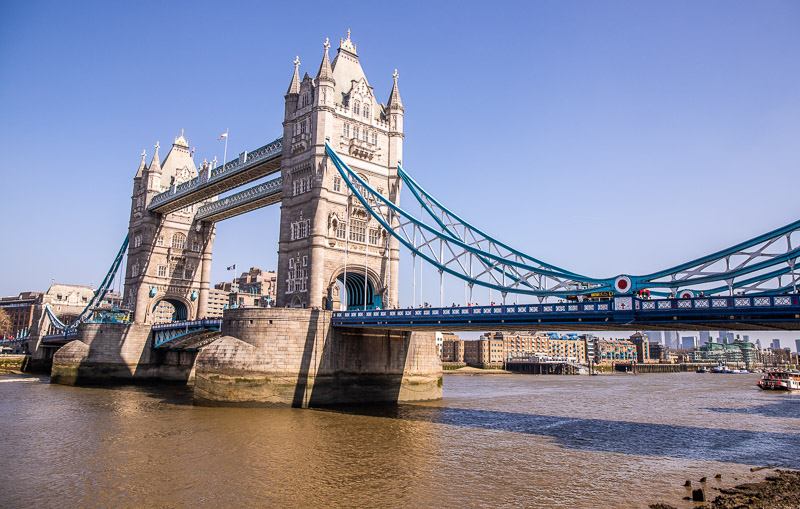
This is the last morbid landmark we’ll share on this list, as I’m sure you don’t want to fill all your explorations of London with death-related attractions, but Dead Man’s Hole is such a unique find that we had to share it.
You’ve probably heard of Tower Bridge, and if not, you’ve undoubtedly seen images of it. It’s the most famous bridge in London and an unmissable landmark.
Below the bridge (on the northern shores) is a tiled alcove that once served as a mortuary in the Victorian era. Yep, this was a place specifically built by the City of London to recover bodies from the River Thames, where they would be cleaned, and then taken for identification.
Bodies were not a rare occurrence in the river during those days, so this temporary mortuary was necessary. Today, it’s just an alcove, and access to the river has been sealed off.
Here are some of the most famous places in London to visit
The Ponds of Hampstead Heath (where you can swim)

Hampstead Heath is not unknown by any means. It used to be an area in London where celebrities would live away from the prying eyes of tourists, but as with all secrets, once it’s out there, it’s out.
However, what many people don’t know about Hampstead Heath, unless you’re local to London, is that you can swim in the ponds.
These are not traditional ponds filled with lily pads and frogs, but bathing ponds, which were built as reservoirs in the 17th and 18th centuries, and now transformed into outdoor swimming pools, or Lidos, as the Londoners call them.
There are three main ponds on the Heath you can swim in (one men’s, one women’s, and one mixed), each one surrounded by woodland and areas of lawn where you can bathe between swims. You have to pay for entrance to the ponds, but it’s not expensive, and they are rarely busy (except during school Holidays in July and August).