Tina Turner Mother Proud Black Buddhist, Black Buddhist History, Half Black & Japanese Female Priest Myokei Shonin, Black activist kicked out of Black Buddhist Society, father of Black Buddhism, Memphis Black community Orange Mound correct birth 1879
MEMPHIS, TN, February 19, 2026 /24-7PressRelease/ — On April 4, 1968 Dr. Martin Luther King was killed in Memphis. African/Americans were at a loss. Blacks in America did not know what to do. One man changed Black America with a song.
Click here to view video titled: NARA Historian Anthony “Amp” Elmore James Brown “Say it Loud” Black Buddhist Chant
In this article we make clear that Black Buddhism is Cultural and not racial. The assertion that “Black Buddhism is cultural, not racial” strikes at the heart of a profound spiritual and sociological distinction.
While race is often an external category imposed by society, culture is the living, breathing expression of a people’s history, values, and resilience. Black Buddhism, therefore, is not a practice defined by the color of one’s skin, but by the cultural lens through which the Lotus Sutra is interpreted and applied.
It is a movement that centers the African American experience—including its music, its struggle for civil rights, and its unique communal bonds—as a legitimate and powerful vehicle for attaining enlightenment. This distinction allows the practice to move beyond the “Asian Buddhist paradigm” and into a space where the rhythm of the Black experience becomes the very pulse of the chant.
By framing Black Buddhism as a cultural phenomenon, we acknowledge that the teachings of Nichiren Shonin are universal, yet their application must be grounded in the actual fact of a practitioner’s environment.
For the African Diaspora, this means a Buddhism that speaks to the trauma of the “Middle Passage” and the triumph of the “Human Revolution” in the face of systemic oppression. It is a culture of “Good Friends” who meet on the common ground of shared heritage to support one another’s spiritual growth. When we say it is cultural, we are saying that Black Buddhism is an act of African Cultural Diplomacy, where the practitioner does not have to strip away their identity to find the Buddha, but rather finds the Buddha through the deep, rich soil of their own cultural history.
Please click here to view our video titled; Tina Turner Mother of Proud Black Buddhist by Anthony “Amp” Elmore
In the lecture, it is explained that the title “Mother of the Proud Black Buddhist World Association” is a logical and honorary designation for Tina Turner based on the three standards of Buddhist evaluation: reason, documented proof, and actual fact.
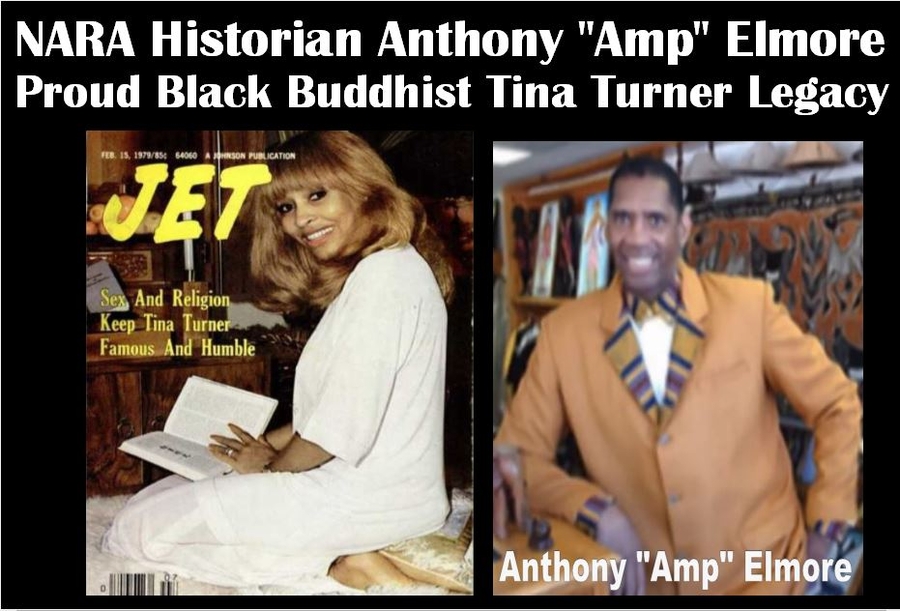
Just as historical figures like W.C. Handy and Ike Turner are recognized as the “fathers” of the Blues and Rock and Roll through documented firsts, Tina Turner is established as the matriarch of this movement because the February 15, 1979, issue of Jet Magazine serves as the first documented public record of an African American person promoting Buddhism in a major Black publication. This documentation is vital because it predates the 1993 film What’s Love Got to Do with It by fourteen years, proving that she was a Black pioneer of the faith long before it became a mainstream Hollywood narrative.
The Association asserts that this Jet Magazine cover is the “birth certificate” of Black Buddhism, providing the necessary historical evidence to reclaim the religion from an exclusively Asian-centric paradigm. By declaring her the “Mother.”
The Association follows the African proverb that “if lions were historians, hunters would no longer be heroes,” taking the authority to write its own history rather than allowing external organizations to erase or overlook the Black Buddhist experience. Ultimately, her role is considered foundational because her life provided the “proof of actual fact,” demonstrating that the practice of the Lotus Sutra could lead to a revolution of the soul specifically within the context of Black culture and struggle.
This story is titled: NARA Historian Anthony “Amp” Elmore Proud Black Buddhist Tina Turner Legacy. Click here to view the February 6, 2016 Anthony “Amp” Elmore Buddhist lecture titled: Tina Turner and Buddhism a new way to pray: by Anthony “Amp” Elmore
The exact words from the You Tube background for this video reads: 1,161 views Feb 6, 2016. This video “Tina Turner and Buddhism a new way to pray” is a Buddhist lecture by Anthony “Amp” Elmore President and Founder of the “Proud Black Buddhist World Association.” Elmore in this lecture notes that “Tina Turner” the queen of Rock and Roll not only “raise the banner” of the “Proud Black Buddhist World Association” Tina Turner is the model and paradigm of a “Proud Black Buddhist.”
Elmore in this lecture makes clear that a “Proud Black Buddhist” is not a racial title but a “cultural Title.” On February 15, 1979 Tina Turner raised the banner of “Proud Black Buddhist Worldwide” by declaring her love, commitment and dedication to the Buddhist faith in the world’s “Number One” Black publication in the world “Jet Magazine.”
Tina’s image in Jet Magazine represents Tina as “Proud Black and Buddhist”, moreover Tina Turner’s image as a “Proud Black Buddhist” on the cover of a “Black Cultural Magazine” is historic and significant in that Tina appeared as a “Proud Black Buddhist” in February or Black history month.
February is not only Black history month but February 16, 1222 is the birthday of the Nichiren Buddhism’s founder Nichiren Shonin who preached the phase Nam(u) Myoho Renge Kyo that Tina Chants.
Anthony “Amp” Elmore President and Founder of the Proud Black Buddhist World Association notes that this February 15, 1979 image of Tina Turner is our organization’s official banner of Buddhist propagation. What better image can we “Black Buddhist have than a Black Buddhist “Cultural Integration” Featuring Tina Turner. Elmore makes note that he kelp this Tina Turner Jet magazine on his Buddhist altar for decades.
Elmore complains that Buddhism is viewed by many as only an “Asian Religion”, moreover Elmore complains that our Japanese Buddhist teachers make it a practice to extricate all Black Buddhist history, culture and language from their Buddhist teachings.
Elmore in this lecture notes that Tina Turner protected the “Tina Turner Buddhist Brand” conscientiously by never allowing any Asian person or any Asian culture to “over shadow” Tina Turner’s cultural image as a “Proud Black Buddhist.” Most important in regards to Tina Turner Elmore notes that Tina Turner elevated her status to the most known and respected Buddhist in our Western Culture.
In this video Tina Turner and Buddhism a new way to pray notes that the “Proud Black Buddhist World Association” are the absolute inheritors of the “Tina Turner way to pray” meaning the “Proud Black Buddhist World Association” represents the nearest Buddhist organization where one can learn and be introduced to Buddhism in the “cultural model of Tina Turner.”
Tina Turner explains in this video that she never compromised her Black cultural upbringing to embrace Buddhism. Anthony “Amp” Elmore notes; “let’s be clear, Tina Turner was raised culturally as “Black Baptist” and she integrated her Black cultural upbringing into her Buddhist faith.
The “Proud Black Buddhist World Association” encourages not only practices “cultural integrity” The Proud Black Buddhist World Association encourages everyone to practice in Buddhist in a way that is “Culturally Inclusive.” In that regard The Proud Black Buddhist World Association is the best organization that truly represents the spirit of Tina Turner.
Anthony “Amp” Elmore notes 5 points the delineate Tina Turner from other Blacks adopting Buddhism that makes her a “Black Buddhist” who practice “Black Buddhism.”
The five major points that establish Tina Turner as the definitive model of Black Buddhism are based on her historical documentation and her refusal to subordinate her identity to external religious hierarchies:
1. Tina Turner represents Buddhism independent of Asian Buddhist Masters, Culture & History. Her practice demonstrates that the Lotus Sutra can be mastered and applied authentically within a Black cultural framework without needing validation from foreign cultural gatekeepers.
2.Tina Turner never allow an Asian to be in her shadow. Throughout her career, she maintained her own light and brand, refusing to let her spiritual journey be used to market or elevate Asian-led institutions or leaders.
3. Tina Turner speaks about Buddhism with logic, intelligence and authority. Her approach was a “science of life” used for her own empowerment and survival, showing that a Black woman is the supreme authority on her own spiritual experience.
4. Tina Turner is the clear and distinct Black model of Buddhism. Her transition from the struggles of Nut Bush to global stardom provides a relatable blueprint for the African Diaspora, proving Buddhist victory is possible through Black resilience.
5. Tina Turner is the first documented Black Buddhist in America in modern day history. The February 15, 1979, issue of the Black Publication of Jet Magazine serves as the “birth certificate” of this movement, providing the documented proof required to establish a legitimate historical tradition.
Elmore notes in this lecture that many are attracted to Buddhism strictly because of Tina Turner. Tina Turner explains in this video that Buddhism was a new way to pray.
Elmore in this lecture notes that Tina Turner as himself joined the SGI/Nichiren Shoshu/NSA Buddhist sect in 1974. Both Elmore and Tina are no longer associated with the Japanese sects of them being their masters. Elmore notes that today in 2026 the SGI continue to mislead many to believe that Tina Turner was always associated with the SGI. Elmore in this video shows Tina Turner at her home in front of a Buddha statue of Shakyamuni Buddha.
The SGI Nichiren Sect reject Shakyamuni as the “True and Eternal Buddha” and they consider Nichiren Shonin as the “True and Eternal Buddha” demonstrates even more that Tina Turner is no longer associated with the SGI Buddhist sect. Moreover Elmore points out that Tina Turner toured Japan twice and she declined to appear in a photograph with SGI leader Daisaku Ikeda as Jazz greats Herbie Hancock and Wayne Shorter.
Elmore in this video explains the meaning of Nam(u) Myoho Renge Kyo and Elmore introduce the “Gohonzon object of Worship” that Tina used to gain her Buddhist faith.
Click on this image to see a Buddhist scene from the 1993 Tina Turner movie “What’s Love Got to do with it.”
This is the exact background written: 276,071 views Apr 17, 2012 Nichiren Buddhist chant the phase Nam Myoho Renge Kyo. This Japanese oriented Buddhist religion is the act foreign culture in America. The act of chanting Nam Myoho Renge Kyo is strange. Unlike the practice in other of Buddhist sects of meditation in Nichiren Buddhism the primary practice is Chanting Nam Myoho Renge Kyo and reciting the Lotus Sutra.
Anthony “Amp” Elmore posted this movie scene as a “Cultural Pathway.” Elmore notes at the Proud Black Buddhist website we emphasize the idea of “Cultural Pathways” as a mechanism to introduce Buddhism in America. Even more specific there must be “Cultural Pathways” to introduce Buddhism to the African American community. The Proud Black Buddhis website is like a Black radio station. The Website is cultural and not racial.
Anthony “Amp” Elmore explains; Nichiren Buddhism in a cultural context. Individuals can view this movie scene and gain the courage to try Buddhism. Anthony “Amp” Elmore notes; African Americans need to view other African Americans practicing Buddhism so they will not feel not so left out.
Antony “Amp” Elmore notes; Chanting is a cultural shock. Most Black people are not going to listen to a Japanese leader. African Americas are articulate. There was Dr. Martin Luther King and we have a Black President Barack Obama Jr. Anthony “Amp” Elmore notes we organized “The Proud Black Buddhist World Association to give African/Americans a voice in the Buddhist faith.
Click here to Learn more:
The February 15, 1979, issue of Jet Magazine stands as a monumental pillar in the history of global Buddhism and African American cultural identity. Long before the world celebrated Tina Turner’s spiritual journey through her 1986 autobiography I, Tina or the 1993 cinematic masterpiece What’s Love Got to Do with It, this specific cover story served as the first public declaration of her Buddhist faith in not just a Black publication, at the time Jet Magazine was the Major Black population in the world.
For the Proud Black Buddhist World Association, this date is not merely a piece of trivia; it is the genesis of a movement. By capturing and archiving this moment, Anthony “Amp” Elmore established the foundational proof that Tina Turner’s spiritual evolution was intrinsically tied to the Black experience and the birth of “Black Buddhism.”
The relationship between Tina Turner and the Proud Black Buddhist World Association is one of spiritual lineage and historical recognition. While mainstream narratives often frame her Buddhism through a lens of individual survival, The Proud Black Buddhist World Association recognizes Tina Turner as the “Mother of the Proud Black Buddhist World Association.”
This title was not bestowed posthumously but is a living recognition of her role as the trailblazer who demonstrated that the practice of Nichiren Buddhism could be a tool for empowerment and liberation for people of African descent. Decades before her passing, she was already the symbolic matriarch of a movement that sought to reclaim Buddhism from Eurocentric or purely Eastern interpretations, grounding it instead in the history and struggle of Black people.
As the legitimate heirs of Tina Turner’s spiritual legacy, the Proud Black Buddhist World Association asserts that her “famous and humble” nature, as noted on the 1979 Jet cover, was the direct result of a practice that transcends mere celebrity. This article serves as the “birth certificate” of a legacy that proves Tina Turner was practicing and speaking on her faith fourteen years before Hollywood brought it to the masses.
The Association carries forward this flame by connecting the dots between her practice and the broader “Black Buddhism” framework—a framework that honors the ancient African roots of spiritual science and the modern-day resilience exemplified by Turner herself.
Today, the Proud Black Buddhist World Association stands as the guardian of this history. While the world remembers Tina Turner as the “Queen of Rock ‘n’ Roll,” the Proud Black Buddhist World Association ensures she is also revered as a spiritual pioneer whose 1979 public testimony changed the landscape of Black spirituality forever. By documenting her journey when no one else was looking, The Anthony “Amp” Elmore Proud Black Buddhist World Association has secured its place as the true repository of the late Tina Turner’s spiritual heritage, continuing the work of “African Cultural Diplomacy” and spiritual liberation that her life so powerfully embodied.
Click here to see video titled: NARA Historian Anthony Amp Elmore Kicked out of Facebook Black Buddhist Society for being too Black
The background to this video reads: The history of Black Buddhism in America is defined by a rigorous struggle for cultural sovereignty, a struggle pioneered by Anthony “Amp” Elmore, the primary architect of the world’s first Black Buddhist website and a “Warrior-Scholar” whose legacy spans decades of independent filmmaking and digital archiving. Elmore stands as the personification of the “Blackest Buddhism” in America—a practice that refuses to accept the “Mahayana Extrication” of African history, instead grounding the Dharma in the forensic truth of the Nile Valley and the global Kushite lineage.
As a filmmaker and owner of the Proud Black Buddhist Digital Museum, Elmore has spent over half a century documenting the “Missing Link” between the ancient Buddha and the Black experience, creating a body of work that challenges the systemic “mis-education” of the Buddhist Negro. His position is not merely one of faith, but of institutional independence; he is the custodian of a sovereign narrative that restores the Buddha to his rightful place as an African king, thereby providing the Black community with a spiritual mirror that reflects their own history rather than an imported Asian culture.
The depth of this conflict was made physically manifest in 2019 when Elmore attempted to engage with the Facebook group known as the Black Buddhist Society. Despite Elmore’s standing as a prolific writer, world-class athlete, and a pioneer who had been on the front lines of Buddhist history for decades, he was met with the hostility of “Black Gatekeepers” who sought to protect the authority of Asian-led and White-led Buddhist structures.
Specifically, individuals such as Myokei Shonin (a leader in the Nichiren Shu sect) and “Brother on the Path” acted as the ideological enforcement for an “Asian/White” Buddhist framework that systematically erases Black history and language from the practice. By expelling Elmore from the group without warning or explanation, these gatekeepers demonstrated the exact “cultural indoctrination” that Elmore has long fought against—a condition where Black leaders, trained by foreign sects like the SGI or Nichiren Shoshu, become dependent on inferior roles and actively suppress any “Auto-didactic” attempt to reclaim a sovereign African-centered Dharma.
Ultimately, the expulsion of Anthony “Amp” Elmore from these mainstream digital spaces serves as a definitive “Line of Demarcation” that distinguishes the Proud Black Buddhist World Association from those practicing a “Negroized” version of Asian Buddhism. While the gatekeepers promoted a version of the faith that required Black practitioners to “check both” or see themselves as “other” to accommodate foreign leadership, Elmore stood as a beacon of uncompromising Blackness, asserting that the “Sacred Science” of the Buddha is the intellectual property of the general Black population.
This 2019 event, documented in the video “Black Buddhist Negroes,” remains a primary forensic receipt of the internal battle within the faith—a battle between those who wish to remain under the “Asian White” cultural filter and the Warrior-Scholars led by Elmore who have moved past the gatekeepers to find the Lotus Sutra carved in the stone of Sudan.
The internal architecture of the “Asian/White” Buddhist structure in America is fortified by
individuals who have adopted an “Other” identity to justify their allegiance to foreign cultural leadership. A primary example of this ideological gatekeeping is Akemi Bailey-Haynie, a prominent SGI leader who famously distanced herself from a Black identity by labeling herself as “Other” within the context of her Buddhist practice.
This designation serves as a profound forensic marker of the “Mahayana Extrication” that Anthony “Amp” Elmore has spent decades exposing. By choosing the label “Other,” Bailey-Haynie and similar SGI leaders effectively participate in the erasure of the Black experience, signaling that to reach the highest echelons of an Asian-led organization, one must first divorce themselves from the “Kushite” reality of their own heritage. This rejection of Blackness is the very “Cultural Indoctrination” that Elmore identifies as the “Mis-education of the Buddhist Negro,” where practitioners are trained to see their own African origins as secondary—or entirely invisible—to the Japanese cultural filter.
The presence of leaders like Akemi Bailey-Haynie within the SGI hierarchy highlights the “Line of Demarcation” between the Proud Black Buddhist World Association and the “Negroized” versions of Asian Buddhism. While Bailey-Haynie and the gatekeepers of the 2019 Facebook
Elmore stood as the “Blackest Buddhist” in America by asserting that the Buddha was a Kushite King. The conflict in 2019 was not a simple disagreement; it was a collision between Independent Spiritual Sovereignty and Institutional Dependency.
To delineate the profound architectural shift between Asian-White Buddhism and Black Buddhism, one must first forensically analyze the distinction between practicing “Buddhism” and practicing the Lotus Sutra. As documented in the 2015 record of the conflict between Anthony “Amp” Elmore and the half Black/Japanese Nichiren Shu Priest Myokei Shonin,
Buddhism as it is commonly understood in America is a cultural import—a system of rituals, Shindoku (Japanese) phonetics, and foreign hierarchies that often demand the practitioner “extricate” their own cultural identity to fit a Japanese or Euro-centric mold.
Conversely, the practice of the Lotus Sutra, as championed by the Proud Black Buddhist movement, is a universal science of life. It posits that the “Supreme Law” is not found in a temple or a foreign priest, but within the cultural soul of the practitioner.
This is the forensic divide: Asian-White Buddhism is an adoption of a foreign culture; Black Buddhism is a reclamation of a universal science that honors the “Cushite” heritage and the sovereign soil of the Black community.
The contrast between Anthony “Amp” Elmore and ½ Black and Japanese female Priest Myokei Shonin serves as the primary forensic evidence of this struggle. Black Nichiren Shu Priest Myokei Shonin, despite her African American heritage, represents the “Asian-White” paradigm—a “bald-headed” institutionalism that is governed by Japanese lineage and the preservation of 13th-century cultural aesthetics.
When Anthony “Amp” Elmore on December 5, 2014 presented Myokei Shonin with the “Eye-Opening” documentation of Tina Turner’s spiritual independence, Myokei Shonin’s demand to be removed from the record was a forensic act of gatekeeping. It represented the institutional fear of a “Stand-Alone” Black practice that does not require an Asian or white intermediary.
The ½ Black and Japanese Nichiren Shu female Priest Myokei Shonin represents a Buddhism that is a “religion” of submission to foreign authority, whereas Anthony “Amp” Elmore and Tina Turner represents the Lotus Sutra as a “science” of sovereign power, where the practitioner—like the Five-Time World Champion himself—is the master of their own environment.
This distinction is precisely why Tina Turner must be forensically categorized as a Black Buddhist. While Tina Turner was living, her practice was a living manifestation of the Lotus Sutra rather than a subservient “Buddhism.” She lived in Europe as a sovereign “Baptist-Buddhist,” famously recording “Amazing Grace” and refusing to allow any Asian leader to stand in her shadow or dictate her cultural expression.
The Tina Turner legacy proves that one can chant Nam-myoho-renge-kyo while remaining rooted in the soul of Nutbush and the frequency of Black Pride. While Asian-White Buddhism seeks to “wash away” the Black experience under the guise of “emptiness” or “equality,” Black Buddhism identifies the Black experience—including the struggle of the “Black Bodhisattvas” like MLK and Mandela—as the actual proof of enlightenment.
For the world to understand this delineation, they must look at the “Actual Proof” of the 1879 Orange Mound founding by Anthony “Amp” Elmore founding versus the 1890 “Slave” narrative promoted by the city of Memphis. Asian-White Buddhism often aligns with the “Gatekeepers” who erase Black history because it views “history” as separate from “spirituality.”
However, Black Buddhism, led by a NARA-honored historian Anthony “Amp” Elmore, recognizes that the Lotus Sutra is the history of the soil. Tina Turner’s spiritual victory was not a fluke of a foreign religion; it was the result of a Black woman utilizing a universal science to reclaim her own life. This story identifies Anthony “Amp” Elmore as the forensic custodian who, for 52 years, has protected this “Black Buddhist” category from being swallowed by the “Rocks” of Asian-White institutionalism, ensuring that the “Gold” of the Lotus Sutra remains accessible to the Cushite soul of Black America.
The February 15, 1979 Jet Magazine is the foundation and the forensic evidence of Tina Turner as a “Proud Black Buddhist.” Unknown and untold is the Tina Turner connection to Anthony “Amp” Edmore’s Black Orange Mound Memphis community.
The inter-related Anthony “Amp” Elmore relationship to Tina Turner goes further perhaps than any person in America. In 1962 there is an image of the Tina Turner at Club Paradise in Memphis of the “Ike and Tina Turner Review.” Elmore notes his parents was at that show and every Ike and Tina Turner show in Memphis.
The 1962 image of Tina Turner taken at Club Paradise was taken by historic photographer the late Earnest Withers who he and his family are Elmore friends. In the Elmore parents family house hold Tina Turner music was a part of the Family whereas Elmore’s older sister Doris would sing and imitate Tina Turner.
It was in 1971 where Anthony “Amp” Elmore had his 1st real girl friend the late “Sherree Harris.” Sherree Harris mother married a man by the name of “John Bullock.” John Bullock was a handyman and his brother was Tina Turner’s father. Tina Turner’s birth name was “Annie Mae Bullock.”
In 1939 when Tina Turner was just born a family related to Anthony “Amp” Elmore moved on Hamilton street in Orange Mound. The family moved from Ashland, Mississippi where Elmore’s parents were born in the area and are distant relatives to Anthony “Amp” Elmore.
The family was the Mitchell family and the elder son Willie Mitchell would become a world- renowned music producer. Who lived in Orange Mound a community who graduated in 1946 from Orange Mound’s Melrose High school. Elmore moved into Orange Mound as a 19 year old home buyer in 1972.
It was March 5, 1951 that Ike Turner recorded the song “Rocket 88,” noted as the 1st rock and roll record. It was on April 7-8 1951 this song was 1st performed by Ike Turner at the W.C. Handy Theatre in Orange Mound. Anthony “Amp” Elmore notes that Rock 88 is considered “The 1st Rock and roll record.” This is 3 years before Elvis Presley more importantly this means “The 1st rock and roll record was performed in the historic Orange Mound community by Ike Turner who is connects to Tina Turner to Orange Mound.
Click here to view an Anthony “Amp” Elmore video titled: Untold Story of Willie Mitchell Orange Mound & Memphis Music
In this video Willie Mitchell explains how he experimented in Jazz chords whereas he noted that the arrangement he came up with could be a hit record. Soul singer Al Green would pin some Lyrics and drummer Al Jackson would come up with a drum beat they recorded a song called “Let’s stay together” in 1971.
Al Green’s “Let’s Stay Together” remains one of the most culturally and historically significant recordings in American music history, far transcending its status as a mere “love song.” Released in 1971, the track served as the definitive architectural blueprint for Willie Mitchell “Hi Records” soul sound, masterminded by producer Willie Mitchell at Royal Recording Studios in Memphis.
Its primary impact was the successful “softening” of soul music; at a time when the genre was dominated by the gritty, high-intensity delivery of artists like James Brown and Wilson Pickett, “Let’s Stay Together” introduced a more tenderhearted, polished blend of the sacred and the secular. By encouraging Al Green to utilize a “thin,” gentle falsetto rather than the traditional gospel shout, Mitchell created a sonic landscape that felt simultaneously romantic and spiritual, bridging the gap between the deep soul of the 1960s and the more refined, orchestral sounds of the 1970s.
In order to get clear understanding of the titled of this writing named: NARA Historian Anthony “Amp” Elmore Proud Black Buddhist Tina Turner Legacy:
Click here to see the Tina Turner video of her preforming the song Let’s Stay together.
The 1983 Tina Turner recording whose roots is in Orange Mound in Memphis. The song “Let’s Stay Together” served as the forensic “Declaration of Independence” for Tina Turner, providing the strategic pivot point that transformed her from a nostalgic ]”Chitterling Circuit” performer into the global Queen of Rock and Roll.
Following her 1976 escape from the physical and professional domination of Ike Turner, Tina struggled for years to find her solo voice, often relegated to the Vegas cabaret circuit where she was viewed as a legacy act rather than a contemporary force. However, when she stepped into the studio with the British production team Heaven 17 to cover Al Green’s Memphis classic, she performed a masterstroke of cultural engineering.
By stripping away the gritty, high-octane “Ike & Tina” aesthetic and replacing it with a sophisticated, synthesized European soul-rock production, she proved that her voice—and her “Warrior Spirit”—could dominate the modern charts without a male intermediary.
This track was far more than a hit single; it was the “Actual Proof” of her spiritual and professional sovereignty. While Al Green’s original was a “Memphis soul sermon,” Tina’s version was a Black Buddhist testament to survival and self-determination. The song’s massive success in the UK and its subsequent climb to the top of the American charts forced the mainstream music industry to acknowledge her as a solo powerhouse, directly paving the way for the multi-platinum *Private Dancer album.
It was this specific record that broke the “Ike Turner Curse,” proving to the world that she was not just a survivor of a traumatic past, but a forward-thinking architect of the future. By reclaiming a Memphis-born soul standard and infusing it with her own “Stand-Alone” energy, Tina Turner utilized “Let’s Stay Together” as the vehicle to ascend her throne, ensuring that from that moment forward, she would be known only as a sovereign global icon.
About Us
“If Lions were historians, hunters would no longer be heroes.” This powerful African proverb encapsulates the mission of the Orange Mound News Network (OMNN). Founded by Anthony Amp Elmore, OMNN aims to reclaim and reshape the narrative of Orange Mound through the power of filmmaking, education, and content creation. Our goal is to challenge the negative stereotypes and biased portrayals that have long plagued our community, creating a positive space for family, Black culture, history, and education.
Our Journey and Mission
Orange Mound, established as the first community in America built for Blacks by Blacks, has a rich history often overshadowed by negative stereotypes. Mainstream media and societal biases have painted Orange Mound as a “ghetto,” contributing to a 30% decline in property values while surrounding communities have prospered. The Orange Mound News Network was created to
counter this narrative and highlight the true spirit and resilience of our community. Anthony Amp Elmore, a five-time world karate kickboxing champion, filmmaker, and community activist, has been a beacon of change in Orange Mound. With over five decades of community service, Elmore has dedicated his life to uplifting Orange Mound. From becoming a homeowner at 19, establishing businesses, to founding the Proud Black Buddhist World Association, Elmore’s contributions
have been immense.
# # #